
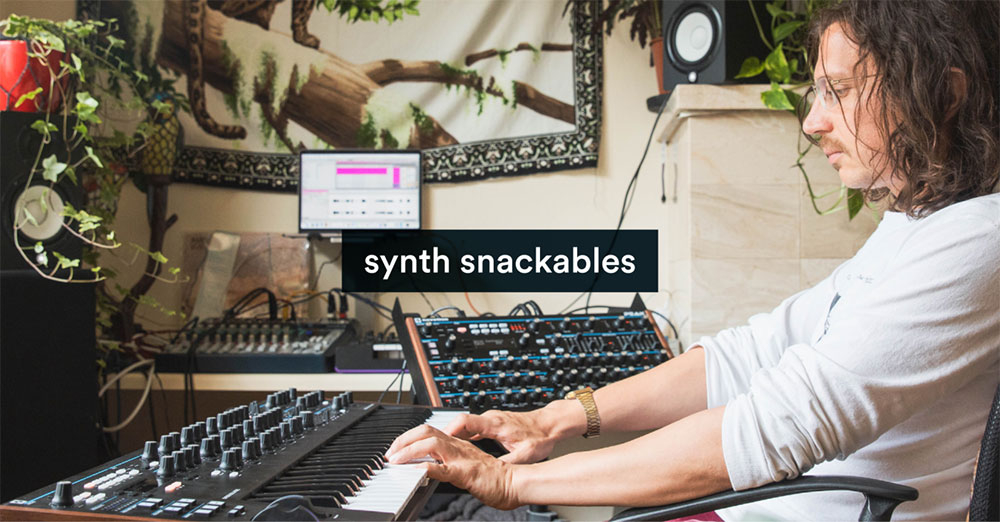
Synth Snackables has been generated by Novation to bring educated artists directly to you. They are sharing their tips and techniques, for outside the box use, of the Peak Synth. The first in the series of videos is with Dutch artist Legowelt, who goes through his five top tips for the Novation Peak Synthesiser, really pushing those limits.
The Peak is an eight-voice polyphonic synthesiser, and to kick off the Snackable Series, Legowelt has provided five great pieces of info to really get the most out of it.
1/ Envelopes Fun
Legowelt talks about negative envelope depth and how it is like “inverting” the envelope. He goes on to show how they can be used to create “springy” effects that sound completely organic.
Legowelt says “the cool thing about the Peak is that you can assign both envelope generators” and then goes on to assign positive and negative mod envelope depth simultaneously to the analogue filter to create an eight-point filter envelope. Asa result, it produces an elated yet eclectic sound, as they are both fighting for control.
Legowelt can gain more fluid and precise control of the filter envelope movement through the use of the generator menu; he describes this in detail more in the video.
2/ Looper Delay
Legowelt recommends starting with a rhythmic sound to get a feel for the beat and timing. He goes on to add delay on a short staccato bass, maxes out level, time and feedback to start the loop. He then explains that adding chords melodies, LFO and effects can create an organic soundscape.
This tip allows endless layers to be played over the top, which results in creating entire tracks in real-time. He goes on to explain that this tip isn’t an endless looper, old sounds are replaced by new overtime, “it does it in a really nice way almost like a tape loop that’s disintegrating”.
3/ Hurdy Gurdy
The basis of hurdy-gurdy is by putting the Peak into a monophonic mode. Legowelt then goes on to assign the fixed note function to play the same note with two oscillators. The third oscillator is available to play a higher note. As a result, you can see how a “jolly” medieval drone is created.
Legowelt goes on to explain that “of course we can make it much more interesting” through assigning pitch range to the two oscillators, adding several LFO modulation and creating movements with filter envelopes.
4/ Drum Machine
Legowelt says “the really cool thing about Peak is that you can modulate the keyboard to a lot of functions” and starts by maxing out filtering resonance and assigning his SL MkIII keyboard as the destination. The lower octaves act as the bass and creates snares and high hats with higher octaves using the noise level.
In the video you see Legowelt go on to use the Peak as a drum machine and goes on to create advanced drum loops, which can be essential for any live setup.
5/ Three-Oscillator Harmonics
Legowelt forms a minor triad by detuning each oscillator pitch with the coarse function. He then goes on to develop deep, dreamy soundscapes by playing other key polyphonically and opening up the sound with envelopes.
He goes on to show how even more depth and richness can be added by adding LFO and modifying the waveforms of the oscillators. After this, Legowelt goes on to demonstrate and even more advanced tip of an effective way to simulate acoustic instruments and add harmonic character.
Novation Components
Legowelt’s talents are endless, and the depth of his knowledge is admirable. His patches from the Synth Snackable session, for both the Peak and Summit Synthesisers, are available as a free download from the Novation Components App now.
More information on Novation's Peak Polyphonic Synthesiser can be found HERE

Share This Article